


Skip to Content
Product Icon

App Ai Media, Ai网站多媒体管理

Technical Name:
app_ai_media
License:
OPL-1
Included Dependencies [1]:
Lines of code:
9,269
Code Value:
¥ 1,112.28
Follow Odoo's public price policy, The code valuation is $12.00 per 100 line code. Here we only get code line of this app. Depends is included.
Here we only get code line of this app. Depends is included. Total line of Source Code. Including .py, .js, .css and xml file.
¥ 68.00 ¥ 68.00
Coupon: 中国区9折 会员赠积分 VIP专享
3
  • Version

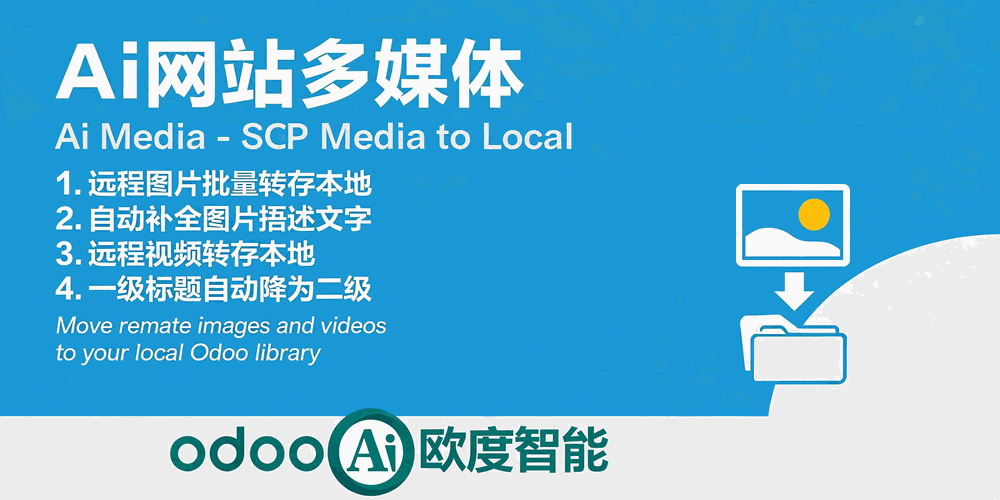
Ai Media — Remote Images and Videos to Local

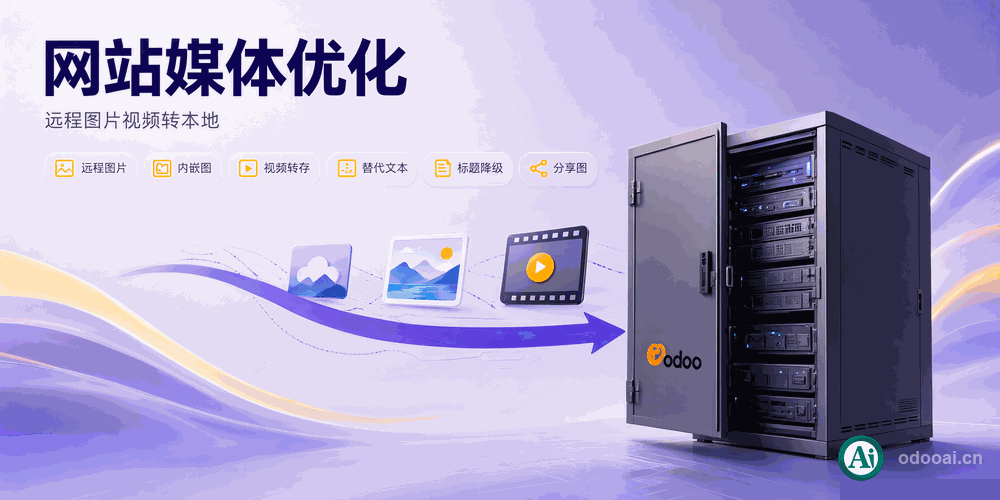
Pull every hot-linked image, inline base64 picture and remote video out of your website content and into Odoo's own attachment storage.
Run it on one record or in bulk from the list view, and let the module write the alt tags your SEO is missing.

Enterprise & Community Multi-Company Multi-Language

Overview

Content copied from another site keeps pointing at that site. When the remote host goes down, blocks your CDN, or changes its URLs, the images and videos on your own pages disappear. This module downloads them into Odoo's attachment storage and rewrites the content to use the local file.

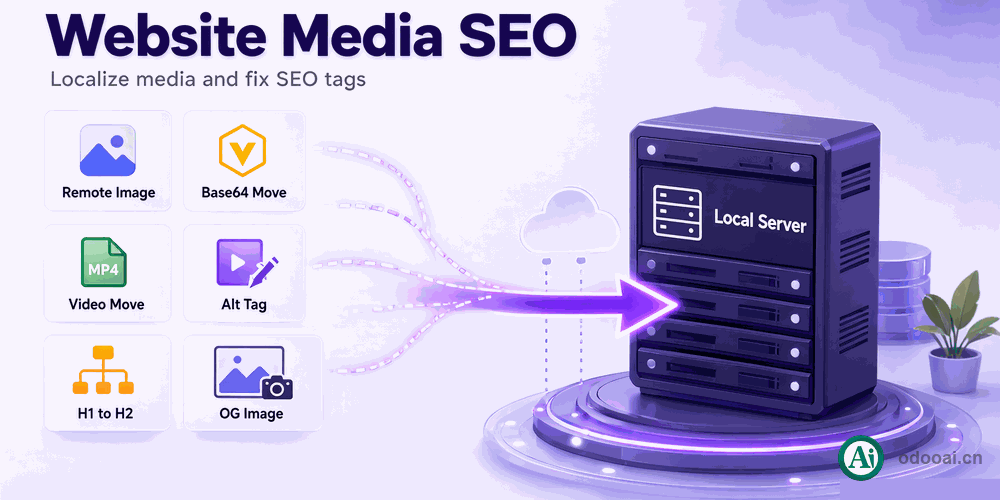
It runs on blog posts, website pages and the website description of product templates, and handles three source formats: remote http(s) images, inline data:image base64 pictures, and remote <video> sources. Alongside the download it does the cheap SEO work that is usually left undone — writing an alt attribute for every image that has none, demoting surplus h1 tags to h2, stripping duplicated id="footer" blocks, and resetting a social share image that no longer resolves. Every file it stores keeps its original remote URL, so a later re-sync is possible.

Complete Feature List

  • 1. Mass get remote image to local
    Remote http(s) images in blog posts, website pages and product website descriptions are downloaded and stored as ir.attachment.
  • 2. Inline base64 pictures converted to real files
    data:image sources bloat the content column; they become normal attachments and the tag is rewritten to the file URL.
  • 3. Access tokens regenerated for existing local images
    A /web/image/<id> link without a token gets a token generated on its attachment rather than being downloaded again.
  • 4. data-original-id and data-original-src written on every image
    Back filled on older records that were localised without them, so a CDN layer can still find the source attachment.
  • 5. Missing alt tags filled from the nearest heading
    Each image looks upwards for h5, h4, h3, h2, then h1 and uses that text; if none exists the post title is used.
  • 6. Extra h1 demoted to h2
    Search engines expect a single h1 per page; the rest are converted to h2 with a mb-2 class, on blog posts and product descriptions.
  • 7. Duplicated footer blocks removed
    A div id="footer" copied in with pasted content is extracted from the record, so the page keeps only the real layout footer.
  • 8. Remote video files downloaded to local
    Every <source> of a <video> tag is fetched and rewritten to /web/content/<id>?download=true.
  • 9. China video platform filters, configurable per website
    bilibili and youku ship as defaults; URLs matching a filter are left remote because those embeds cannot be downloaded anyway.
  • 10. Broken social share image reset
    An og:image still pointing at an old domain is replaced with the website's default social image, or cleared if there is none.
  • 11. Synchronous or queued download, set in Configuration
    Pick synchronous while tuning one page; switch to asynchronous so a bulk run over thousands of posts goes through queue jobs.
  • 12. Oversized images resized, webp recognised
    Attachments are downscaled to the configured maximum pixel size on save, and the mimetype check reads the webp signature instead of trusting the file name.

Key Highlights

1. Hot-Linking Ends Here

Select records in the list view and run one server action.

Content stops depending on someone else's server. A notification reports how many media files moved, so you know whether anything was left behind.

2. Alt Tags Written For You

The heading above each image becomes its alt text.

Empty alt attributes are the most common on-page SEO defect in migrated content, and the most tedious to fix by hand. This reads the surrounding structure instead of inventing filler.

3. Nothing Is Downloaded That Should Not Be

Own domain, CDN domain and China video platforms are skipped.

Your already-local files are left alone, and bilibili or youku embeds stay remote — downloading them would break the player without saving anything.

4. Bulk Runs Do Not Time Out

Switch the setting from synchronous to asynchronous.

A single page downloads in front of you; a whole blog backlog is handed to queue jobs, so the browser is not waiting on hundreds of remote fetches.

General Features

Multi-Language & Multi-Company

Works with any language and company structure.

Full Version Support

Odoo 18/17/16/15/14, Enterprise, Community and odoo.sh.

Full Open Source

Python and XML, easy to audit and extend.

How It Works

1
Install

Install Ai Media on top of Website Blog. Actions appear on blog posts, website pages and products.

2
Configure

In Settings choose Synchronous or Asynchronous saving, and edit the China video URL filters per website.

3
Select and Run

Tick records in the list view, then run SEO: Image 2 Local, SEO: Video 2 Local or SEO: Product Website Description.

4
Read the Result

A notification reports images moved out of images found, and how many alt tags were added.

Supported & Dependent Modules

website_blog app_common queue_job (for asynchronous saving)
Ai Media Remote Images and Videos to Local Banner

Professional Odoo Solutions: Development, Implementation, Consulting & Training

odooAi.cn — https://www.odooai.cn · Live Demo

Specifications

Version 20.0, 19.0, 18.0, 17.0, 16.0